The best SEO forums to join in 2026, and how to get your own forum ranking
The best SEO forums to join in 2026 are Google's Search Central Help Community for indexing and Search Console problems, r/SEO and r/bigseo for everyday questions, WebmasterWorld for long-running Google update threads, and Local Search Forum for Google Business Profile and local rankings. All ten forums below had new threads or replies in the day or two before we checked them on October 13, 2026.
We opened every forum on this list, found its newest thread or reply, and wrote down the date. Anything closed, locked behind a login, or quiet for months is in a short section near the end, so you know why a familiar name is missing. The list is grouped by what you need help with, since a suspended Google Business Profile and a JavaScript rendering bug belong in very different rooms.
If you're here because you run a forum and want it to rank, the second half of this page covers that.
SEO forums at a glance
General SEO forums
WebmasterWorld
WebmasterWorld is the old guard, and it's still where site owners compare notes when Google moves. Each month gets its own Google observations thread (October 2026's had 42 messages by October 12) where members post what dropped, what recovered and what they think caused it. The Google Search and SEO board alone holds 694,216 messages, and there's a newer board for AI search topics. It suits people who run their own sites and want a long memory more than beginners chasing a quick fix. Registration is free, with an optional paid Pro membership. Newest reply when we checked: October 13, 2026, on a thread asking whether Google Search has actually gotten worse.
seoforum.com
seoforum.com is a younger, lighter forum with boards for on-page, technical, link building, local, analytics, algorithm updates and AI search. Much of what you see first is SEO news, posted by a house account and then discussed, so it works as a daily digest. The rest is mostly beginner questions; “What SEO strategies should beginners learn first in 2026” was one on check day. It's a calmer room than Reddit for newcomers, though experienced SEOs will find less depth. Free to join. Its front page showed ten threads updated on October 13, 2026.
Local SEO forums
Local Search Forum
Local Search Forum is run by Sterling Sky and is the most focused room on this list. Its Help & Support for Google Local board alone has about 7,300 threads and 48,000 messages on suspended profiles, missing reviews, service-area quirks and sudden ranking drops. If you manage Google Business Profiles for a living, or your own listing just got suspended, start here. Registration is free, and there's a separate members-only section for LocalU. New threads on October 13, 2026 included one on getting citations indexed.
Google Business Profile Community
The Google Business Profile Community is Google's official help forum for business listings. Bring it verification failures, duplicate listings, suspensions and reviews that break the rules. Answers stay close to Google's policies, which makes it reliable for fixing a listing and thin on ranking strategy. Free with a Google account. Its thread list showed posts updated on October 13, 2026, including a request to merge duplicate profiles without losing reviews.
r/localseo
r/localseo calls itself a community for local SEO news, tips, help and case studies. Threads lean practical: which grid rank tracker has a usable free tier, why a brand-new profile got suspended, how a local business should track AI visibility. It's faster and more casual than Local Search Forum and makes a good second opinion. Free. Newest post: October 13, 2026.
Google and technical SEO forums
Google Search Central Help Community
Google's Search Central Help Community is where a Search Console problem goes: pages crawled but not indexed, a sitemap that won't read, the wrong site name in results, a manual action. Volunteer Product Experts answer many of the threads, and on check day a Diamond Product Expert had replied to a recrawl question 11 hours earlier. It's the right first stop for anyone fixing their own site and the wrong place to argue ranking theory. Free; you post with a Google account. Threads were updated on October 13, 2026.
r/TechSEO
r/TechSEO is “dedicated to the tech nerd side of SEO,” in its own words: crawling, JavaScript rendering, schema, log files, migrations. Most people there are developers and technical SEOs, so a narrow question gets a narrower, better answer than it would in r/SEO. Free. Newest post we saw: October 12, 2026, asking for open-source technical SEO tools.
Reddit and Q&A communities
r/SEO
r/SEO is the default answer for a reason. It's busy around the clock, and its description now covers AI SEO, GEO and LLM visibility alongside technical and content work. Expect a wide mix, from first-week beginners to agency owners, and judge each answer on its reasoning rather than its confidence. Free. Two new posts went up within three hours of our check on October 13, 2026.
r/bigseo
r/bigseo describes itself as run by professional SEOs, and it's moderated harder than r/SEO. Beginner questions go in a weekly help thread, which keeps the main feed for practitioners talking shop: a roofing company whose map rankings stop at the city line, traffic lost after a core update. Service offers, “DM me for help” replies and link sales are against the rules. Free. The latest weekly help thread went up on October 12, 2026.
Webmasters Stack Exchange
Webmasters Stack Exchange works like Stack Overflow: one precise question, voted answers, one accepted. It's slow now, at about five new questions a month as of October 2026. The archive is the draw. It holds 38,781 questions, so a lot of technical problems are answered before you need to ask, and the bar for an accepted answer is high. Free. Newest question: October 13, 2026, on improving AEO with Search Console data.
SEO forums we checked and left off
A few names still show up on older lists. Here's why they're not on this one.
Moz Q&A closed on December 12, 2024, after more than 13 years. New posts and replies are locked, though many old threads are still readable.
Warrior Forum still runs a busy marketing forum, but its SEO board has gone quiet. The newest thread in its most recent view dated from mid-July 2026, about 13 weeks before our check.
Digital Point asked us to log in before it would show any forum page on October 13, 2026, so we couldn't confirm it's active.
Private SEO communities (not in the count)
Some of the best SEO conversation happens in Slack, where we can't read the threads to check them. Two are worth knowing about anyway.
Traffic Think Tank is a paid, private Slack for search marketers, now part of Search Engine Land, billed monthly or yearly. Women in Tech SEO is free. Its newsletter is open to everyone, and its Slack and Facebook groups are for people of marginalised genders.
How to get a useful answer in an SEO forum
Pick the room that matches the problem. Indexing and Search Console errors go to Search Central, profile suspensions to Local Search Forum or the Google Business Profile Community, and strategy debates to r/SEO or WebmasterWorld.
Then give people something to work with. Share the URL if you can (or an honest description if you can't), say what changed and when, paste what Search Console reports, and list what you've already tried. A question with a date and a screenshot gets a diagnosis. “My traffic dropped, help” gets guesses.
Treat private messages offering to fix it for you with suspicion. r/bigseo bans “DM me for help” for good reason.
Running your own forum? How to make it rank
A forum ranks when its threads are public to read, each thread answers one clearly titled question, thin pages stay out of the index, and the whole thing runs on your own domain. Get those right and every answered question becomes a page that can rank in Google and get quoted by AI assistants. The forums above are working proof.
I run demand gen, so I care about this the unromantic way: traffic that turns into pipeline. Here's what actually moves rankings for forum and community content, the AEO layer that gets threads cited by AI answers, and how to turn what members write into a content engine. If you don't have a forum yet, start with how to create a forum website or adding a forum to your website and come back.
Does a forum actually help SEO?
Yes, under two conditions: the content is public, and the structure lets Google make sense of it. A forum behind a login contributes nothing to rankings, whatever else it does for retention. A public one gives you something blogs struggle to produce, which is long-tail coverage at scale. Members phrase questions the way real searchers type them, in words no keyword tool surfaces, and a few hundred active members will write more genuine question-shaped pages in a year than a content team could brief.
It also keeps itself fresh. Threads collect replies for months, and pages that keep changing keep getting recrawled. Google's “Discussions and forums” results and the AI answer engines both draw on community content because it reads like firsthand experience, and public, structured threads are the material they quote.
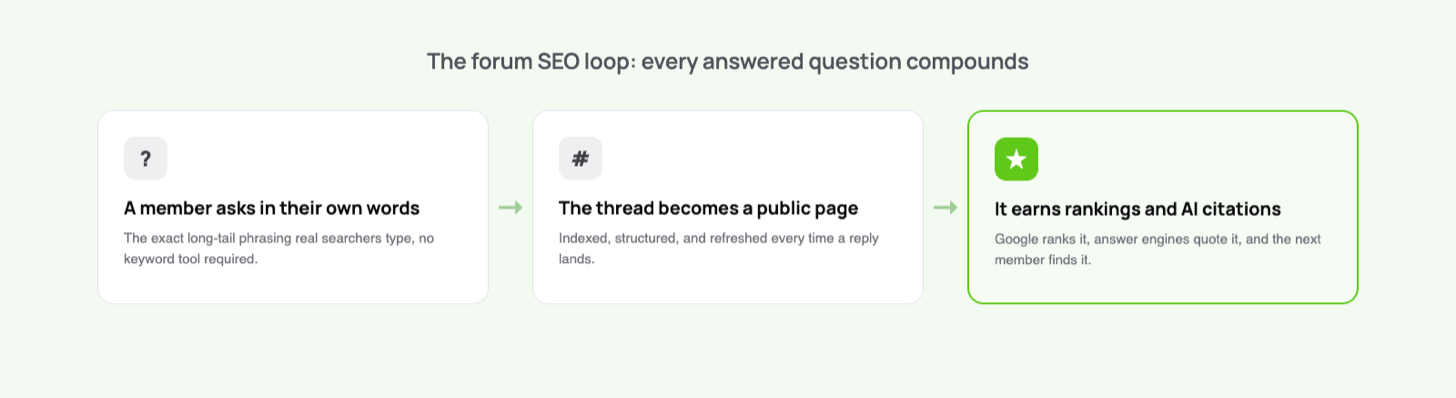
The catch is that a dead or thin forum can hurt. A hundred zero-reply threads are a hundred thin pages, and search engines notice the pattern across the site. The fix is index hygiene, covered below.
How search engines handle forum content
Search engines treat a forum like any other set of pages, with two quirks worth knowing. They reward what a healthy community produces anyway: pages that answer a specific search query, change often, and pick up internal links as members point back to old threads. When someone searches a question your members already discussed, a well-structured thread is a real contender, and it keeps earning long after the conversation ends.
They also judge quality in aggregate. A section full of thin, zero-reply pages drags on the whole domain, which is why index hygiene matters more on forums than anywhere else on your website. Feed search engines your best threads, hide the scaffolding, and the community section can become some of the strongest content on the site.
Forum keyword research: your members write the keyword list
Traditional keyword research starts in a tool and guesses at demand. A community inverts that. Members hand you the keywords by asking questions in their own words, including the long-tail phrasings no tool has volume data for. Skim a month of thread titles and you're reading a keyword list with proof of demand attached.
Use it in both directions. Let threads rank for the long-tail queries they naturally contain, and pull the recurring themes into your blog's keyword plan, where a proper guide can chase the head terms with real search volume. The forum covers questions too specific to brief; the blog covers keywords too competitive for a thread.
Forum SEO best practices
Roughly in order of impact:
- Keep it public to read. Login to post is fine. Login to read means search engines see nothing and rank nothing. Keep genuinely private spaces private and let the rest compound in the open.
- One question per thread, with a real title. “How do I connect HubSpot?” ranks. “Help please!!” doesn't. Nudge members with a title prompt and rename threads editorially when it helps, because the thread title is your title tag.
- Mark accepted answers. A question page with a visible best answer is the shape both Google and AI engines want to quote. Platforms with native Q&A do this for you.
- Merge duplicates instead of letting them split signals. Ten half-answered versions of one question rank worse than one thorough thread. It's boring moderator work that shows up as SEO in the analytics.
- Practice index hygiene. Noindex member profiles, tag pages and other thin templates, so Google spends its crawl on threads with answers. This is the most skipped item on the list, and skipping it is how forums end up “hurting SEO.”
- Link between your blog and your threads. Blog posts should cite the threads they grew from, and busy threads should link to the deeper guide. Internal links are how forum pages inherit authority from the rest of your site.
- Run the forum on your own domain. community.yourbrand.com or yourbrand.com/community both work. A vendor's domain builds the vendor's authority, not yours.
Zero-reply threads deserve their own fix, because index hygiene only hides them. Someone has to notice when a question worth answering stalls and pull in the member who knows the answer. On a Bettermode community that's the job of Toggy Grow, which drafts the follow-up or the introduction and queues it for you to approve before it goes out under your name.
The technical checklist for forum SEO
Most modern community platforms handle the fundamentals, so treat this as an audit list rather than a build list. Clean, readable URLs that include the thread title. Server-rendered pages, since client-side-only rendering still gets indexed slower and less reliably. Canonicals on paginated threads pointing where you want the signal. An XML sitemap that includes threads and leaves out the noise. Q&A structured data on question threads. And speed: forums get heavy with avatars and embeds, so lazy-load media and keep the first answer visible without JavaScript gymnastics.
If you're choosing software partly on this, our comparison of 13 community platforms notes which ones treat SEO as native and which treat it as an afterthought. Bettermode, which we make, runs public communities on your own domain with SEO controls on every plan, and you can try it for 14 days without a credit card through a trial.
AEO: getting your community cited by AI answers
Answer engine optimization, or AEO, is the work of making your content the material AI assistants quote when they answer a question. Community content is well suited to it: firsthand, specific, and written by people using the product rather than selling it. When someone asks an assistant which tool handles their use case, the answer gets assembled from whatever public, readable content the engine can reach. If your community is public and well marked up, some of that can be yours. If it's walled off, the answer gets written from Reddit and review sites instead.
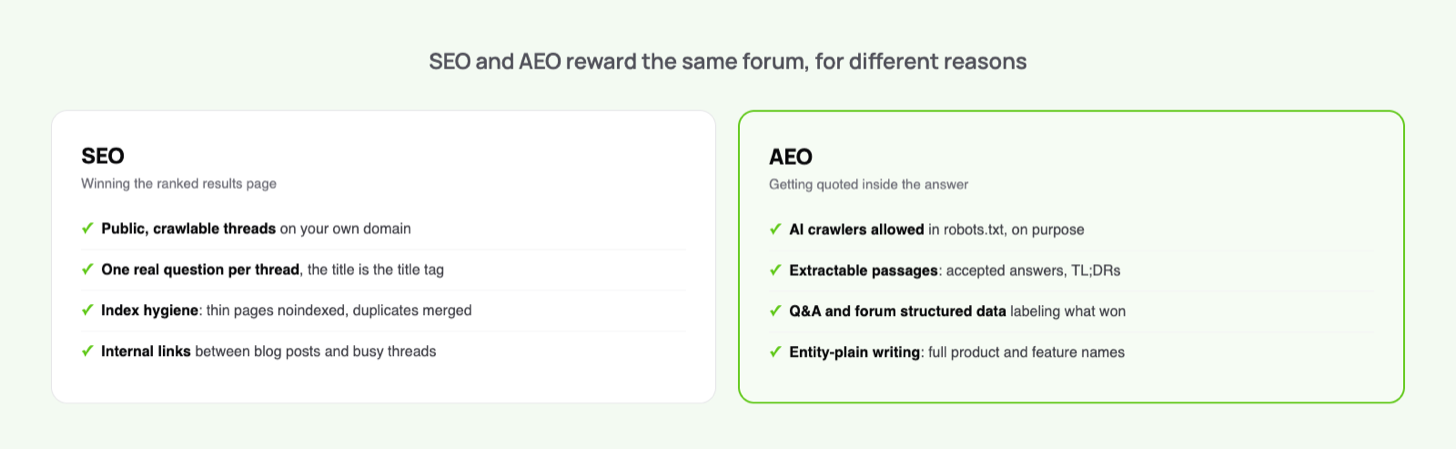
The practices overlap with classic SEO, but the emphasis shifts.
Let AI crawlers in, deliberately. OpenAI documents separate crawlers for search and for model training, so you can allow OAI-SearchBot to appear in ChatGPT's search results while blocking GPTBot. Anthropic (Claude-SearchBot) and Perplexity (PerplexityBot) publish theirs too. Blocking all of them on a public forum protects nothing and takes you out of the answers, so make it a conscious call in robots.txt rather than a default.
Write extractable answers. Question-shaped titles, the accepted answer near the top, a short summary on long threads. Engines lift passages, so the unit of optimization is the paragraph, and a paragraph that answers cleanly on its own is the one that gets quoted.
Use the structured data built for this. Google documents discussion forum markup for threads and Q&A page markup for questions with a best answer. Google retired FAQ rich results on May 7, 2026, so FAQ markup no longer earns a search feature on its own.
Be entity-plain. Name the product, the version and the integration in full. Pronouns and internal nicknames read fine to members and badly to a model deciding what a thread is about.
We watch this from the inside at Bettermode. When we audited our own Search Console in August 2026, 188 long, conversational queries (questions typed the way you'd ask a chatbot) were clicked at 1.29% of impressions, against 0.25% for short head terms. That's about five times the click-through on far fewer searches. My read is that an indexable community is one of the few ways a smaller brand gets quoted next to bigger ones.
An SEO plan for community content
Ranking the threads is half the play. The other half is treating the forum as the research department for everything else you publish, which is where a community turns into an SEO plan.
Mine the questions. The threads members start are a running list of what your market wants explained, the same signal a voice of the customer program works hard to collect. When the same question shows up three times, that's a brief for a definitive blog post, written with the words members actually used and linking back to the discussion. I've built whole quarterly content calendars this way, and those pieces beat the ones we invented in planning meetings, because the demand was proven before the first word was written.
Harvest the answers. Long, expert replies from your best members are first drafts of guides, FAQ entries and knowledge base articles. Ask permission, credit the author, and you get content in a real practitioner's voice plus a member who now feels like a co-author. That loop, community feeding content feeding community, is why I'd file a community forum under growth in the budget.
The brand effect is real too, if slower. A public community full of customers helping each other is proof no landing page can fake. People search your brand, land on threads, and see the product working.
FAQ
What is the best SEO forum?
For most people it's Google's Search Central Help Community for indexing and Search Console problems, and r/SEO for everything else. Local businesses get more from Local Search Forum and the Google Business Profile Community. Technical SEOs should add r/TechSEO, and site owners tracking Google updates still gather on WebmasterWorld. Every one of them had new posts within a day or two of our check on October 13, 2026.
Are SEO forums still active?
Some are, some aren't. Google's two help communities, the main SEO subreddits, WebmasterWorld, Local Search Forum and seoforum.com all had new threads on or just before October 13, 2026. Moz closed its Q&A forum on December 12, 2024, and Warrior Forum's SEO board had no new thread for about three months before that date. Plenty of SEO talk has also moved to Reddit and private Slack groups.
How can an owned customer community help my brand show up in ChatGPT and AI search answers?
Only if it's public. AI assistants build many answers from web pages they can retrieve, and a crawlable community adds pages where customers describe your product in their own words. It can't guarantee a mention. Allow the search crawlers (OAI-SearchBot, Claude-SearchBot, PerplexityBot), keep each thread to one clear question with an accepted answer, and name products in full. Expect Reddit and review sites to keep carrying weight alongside it.
Is a forum good for SEO?
A public, well-structured forum is one of the strongest SEO assets a company can own. It covers long-tail questions at scale, stays fresh on its own, and produces the firsthand content that Google's “Discussions and forums” results and AI engines draw on. A gated or neglected forum does nothing or mildly hurts, so the answer depends on execution.
How do I do SEO for a forum?
Keep it public to read, enforce one real question per thread, mark accepted answers, merge duplicates, noindex thin pages like profiles and tags, link threads and blog posts to each other, and run it on your own domain. Structure and index hygiene beat any trick.
Do forum backlinks help SEO?
Dropping links in other people's forums is the oldest spam tactic around, and it stopped working years ago; many forums nofollow links anyway, and r/bigseo bans link sales outright. The value runs the other way. Own a forum whose threads answer things well enough that other sites link to them.
What is an SEO forum?
The phrase has two meanings. An SEO forum is a forum about SEO, where practitioners trade tactics, like r/SEO or Google's Search Central Help Community. Forum SEO is the practice of getting your own community's content to rank in search, which the second half of this page covers.
TL;DR
- Ten SEO forums had new threads within a day or two of our October 13, 2026 check: WebmasterWorld, seoforum.com, Local Search Forum, the Google Business Profile Community, r/localseo, Google's Search Central Help Community, r/TechSEO, r/SEO, r/bigseo and Webmasters Stack Exchange.
- Start with Search Central for indexing problems, Local Search Forum for Google Business Profile trouble, and r/SEO for everything else.
- Moz Q&A closed in December 2024, Warrior Forum's SEO board has gone quiet, and Digital Point now asks you to log in before it shows threads.
- To make your own forum rank: public read access, one real question per thread, accepted answers, merged duplicates, noindexed thin pages, blog-to-thread links and your own domain.
- For AI answers, allow the search crawlers, write answers that stand alone, and use discussion forum and Q&A markup. Google retired FAQ rich results in May 2026.